Your Profile Code

CET

Feel Artist

Surface Labels

Input-feedback loop Friction removal Onboarding / UX Immediate emotion Retention feel
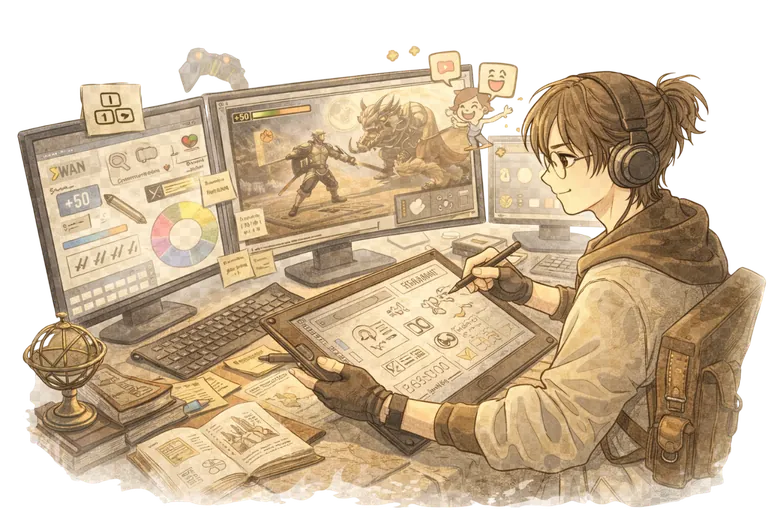
CET character

Feel Artist

A game should feel smooth moment-to-moment; friction is the fastest way to lose players before fun even appears.

Core Traits

CET cares most about the full loop that starts at the player's fingertips and ends as an emotional response. Even if the system is brilliant, if controls feel stiff, feedback is late, or UI is unfriendly, churn happens before fun even appears.
So CET uses testing and observation to find small frictions quickly, and repeatedly tunes tutorials, feedback, and difficulty curves so the desire to "keep going" never breaks. In short, CET prioritizes feel and emotional response and shaves friction to create momentum.

CET's lens aligns with Flow theory: before the challenge-skill balance breaks, they reduce input latency and cognitive load so players can always pick the next action. The fun CET tunes is less about macro structure and more about a frictionless loop repeating moment to moment.

In practice, CET assumes players feel before they understand. Hit feel, responsiveness, information clarity, and the timing of psychological rewards ("I did it" / "I get it") shape the emotional line.
Teams with CET tend to surface core fun faster and secure tactile quality that translates into recommendation and return visits.

profile values banner

Core Values

North Star

A game should feel smooth moment-to-moment; friction is the fastest way to lose players before fun even appears.

Situational Behavior

  • When requirements are vague, you look for where players stop (confusion, delay, failure loops) and fix feedback, clarity, and controls at that point.
  • In technical trade-offs, you prioritize latency, frame stability, camera timing, and responsiveness; you will cut features to protect feel.
  • Under schedule pressure, you favor small friction cuts with outsized impact on early churn and frustration.
  • When feedback conflicts, you defer to observed player behavior patterns over internal intent and adjust accordingly.

Operational Style

  • You tune balance with perception in mind; numerical fairness can still feel unfair if feedback and readability are weak.
  • You iterate through playtests and treat UI, sound, animation, tutorial, and difficulty as one feedback loop.
  • In live ops, you keep adding convenience and onboarding polish, while protecting identity so optimization does not flatten the game.
  • Your release gate is feel quality; small stutters and unclear feedback accumulate into a cheap overall impression.
profile strengths banner

Strengths

  • Reduce early churn. You help players quickly understand what to do and whether they did well, making the first session smoother.
  • Increase perceived polish. You refine feel, feedback, and information flow so even the same content feels more fun.
  • Shines in: tutorials/onboarding, core loop refinement, Polishing, UX/accessibility improvements, and long-term convenience accumulation in live service.

Trade-offs

  • If you over-optimize for short-term reactions, strengthening long-term depth (meta diversity, strategic space) can lag.
  • Feel improvements can fall into endless tweak loops. You need to keep re-evaluating the north star and cost/benefit.

Team Chemistry

Representative Games

Journey

Journey

GRIS

GRIS

INSIDE

INSIDE

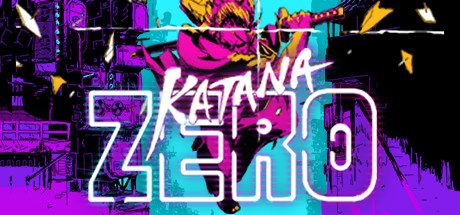
Katana ZERO

Katana ZERO

Hi-Fi RUSH

Hi-Fi RUSH

Ori and the Will of the Wisps

Ori and the Will of the Wisps

References

Work Link
Hunicke, R., LeBlanc, M., & Zubek, R. (2004). MDA: A Formal Approach to Game Design and Game Research. https://aaai.org/papers/ws04-04-001-mda-a-formal-approach-to-game-design-and-game-research/
Juul, J. (2002). The Open and the Closed: Games of Emergence and Games of Progression. https://www.jesperjuul.net/text/openandtheclosed.html
Juul (DiGRA DOI record) https://dl.digra.org/index.php/dl/article/view/214
Pacini, R., & Epstein, S. (1999). The relation of rational and experiential information processing styles to personality, basic beliefs, and the ratio-bias phenomenon. https://doi.org/10.1037/0022-3514.76.6.972
Denisova, A., et al. (2024). Towards Democratisation of Games User Research. https://doi.org/10.1145/3677108
Isbister, K., & Hodent, C. (Eds.). (2018). Game Usability: Advice from the Experts for Advancing UX Strategy and Practice in Videogames. https://global.oup.com/academic/product/game-usability-9780198794844