
Definition
SC asks where player fun and immersion mainly come from. S leans toward fun from recognizing patterns and getting better at them, while C leans toward immersion from emotional involvement in scenes, characters, and mood.
(Pattern recognition / learning ↔ Emotional immersion)
SC asks where player fun and immersion mainly come from. S leans toward fun from recognizing patterns and getting better at them, while C leans toward immersion from emotional involvement in scenes, characters, and mood.
(Decision / Specification ↔ Experiment / Observation)
DE represents whether decisions are aligned through prior hypotheses, specs, and principles, or refined iteratively through implementation, play, and observation.
(Clear constraints / control ↔ Looser rules / player-led interaction)
TM asks how to run rules, roles, and behavior constraints. T leans toward clear limits that strengthen a readable schema and game-like tension, while M leans toward looser rules that invite player-led interaction and emergence.
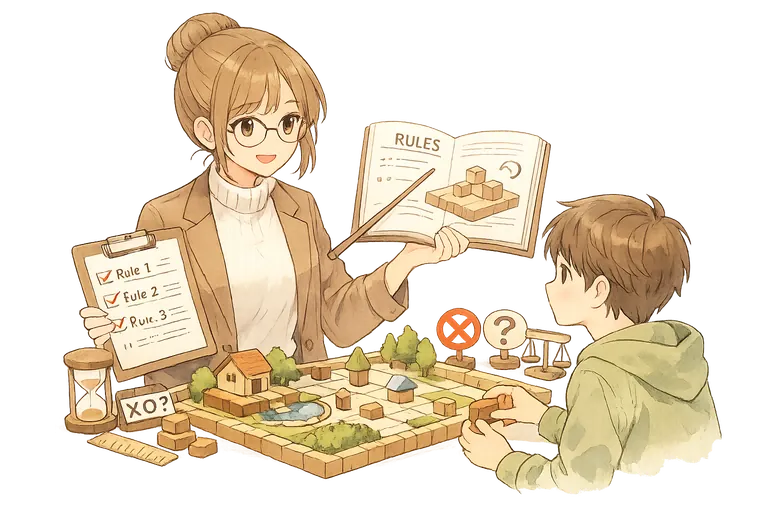
A game should be a fair test of skill inside the magic circle created by clear rules, where even a loss has a clear, understandable reason.
View detail
A game should be a playground where fun emerges from systems and player invention, not designer-provided answers.
View detail
A game should reliably produce the intended experience, and decisions should align through observation and verification.
View detail
A game should be a long-running ecosystem shaped by players, and live ops is design work to keep it healthy.
View detail
A game is a medium for emotion and meaning; what players feel is the final product.
View detail
A game should be a coherent world where player choices produce outcomes that make sense in-context.
View detail
A game should feel smooth moment-to-moment; friction is the fastest way to lose players before fun even appears.
View detail
A game should be a social space where players gain meaning through each other, and trust sustains long-term fun.
View detail| Work | Link |
|---|---|
| Hunicke, R., LeBlanc, M., & Zubek, R. (2004). MDA: A Formal Approach to Game Design and Game Research. | https://aaai.org/papers/ws04-04-001-mda-a-formal-approach-to-game-design-and-game-research/ |
| Juul, J. (2002). The Open and the Closed: Games of Emergence and Games of Progression. | https://www.jesperjuul.net/text/openandtheclosed.html |
| Juul (DiGRA DOI record) | https://dl.digra.org/index.php/dl/article/view/214 |
| Pacini, R., & Epstein, S. (1999). The relation of rational and experiential information processing styles to personality, basic beliefs, and the ratio-bias phenomenon. | https://doi.org/10.1037/0022-3514.76.6.972 |
| Denisova, A., et al. (2024). Towards Democratisation of Games User Research. | https://doi.org/10.1145/3677108 |
| Isbister, K., & Hodent, C. (Eds.). (2018). Game Usability: Advice from the Experts for Advancing UX Strategy and Practice in Videogames. | https://global.oup.com/academic/product/game-usability-9780198794844 |
| 최라마 - 게임 개발자 유형 4가지 | https://youtu.be/7j0NNhxf-Ug |